Ears on backwards
I was feeling lazy today. Nobody required any hacking, I'd already clipped the hedges and done the washing, so I decided to haul my sorry arse down to the local cinema. At $6 a ticket, I couldn't lose, right?
Wrong.
My regular reader probably remembers that I read The Devil Wears Prada a little while ago (mainly because I borrowed it from her and because I haven't returned it yet). The book was no great work of literature, but I didn't mind it. I was duly horrified by the evilness of the evil editor and identified with the misery induced by working in print media. Unfortnately, I couldn't leave it there. No, I wondered what sort of film it would make. I had great hopes for Meryl Streep as uber bitch fashion magazine editor, Miranda Priestley. See, she looks splendidly vicious, don't you think?
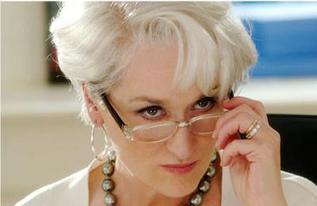
When the credits rolled at the end, I didn't take note of who wrote the screenplay. Whoever it was, if I were Devil Wears Prada author Lauren Weisberger, I'd be daydreaming about taking out a hit on that person. I'd probably be having that daydream while lying on my private island purchased with the proceeds of the screen rights, but that's beside the point.
A few years ago, a journalist asked Louis de Bernieres during an interview what he thought of the movie version of Captain Corelli's Mandolin. de Bernieres said, "It would be impossible for a parent to be happy about its baby's ears being put on backwards." (Of course, the movie version also bought him a lovely little cottage somewhere on an English moor - also beside the point, since we're talking about Artistic Integrity.)
One of my pet hates is movies made from books where some smug git has decided to change the end and/or other important parts of the story. I know The Devil Wears Prada is a fairly fluffy example as books-gutted-on-film go, but it happens to be the most recent one I've seen. The movie version stripped out so many things that were integral to the story. For example, the book's protagonist - Andy, the poor downtrodden assistant with New Yorker dreams - had a boyfriend named Alex who was rather saintly and a teacher; inexplicably, in the movie version, he has turned into trainee chef named Nate. Why? Can people identify with chefs named Nate and not with teachers named Alex? Next problem: Andy's best friend has gone from being a white alcholic who is studying for a PhD in Russian literature and who has a serious accident towards the end of the story, to being an African-American art photographer with no apparent substance abuse problems and who remains wide awake and coma-free.
These things were, however, quite minor compared to the major problem with the movie. Meryl Streep's Miranda Priestly turns out to be almost human and Andy ends up almost fond of her after she gives her a reference for a job on a newspaper. Come on, the woman was meant to be Lucretia Borgia melted down in a septic tank with Lady MacBeth, Myra Hindley and a bushell of cockroaches! There was a reason the author called it THE DEVIL Wears Prada. If it was meant to be A Minor Demon with a Secret Heart of Gold Wears Prada, then that would have been the title.
Of course, this isn't the first time a scriptwriter has thought he or she as known better than the poor bastard who dreamed up the characters and story, suffered through the birth and a dozen edits of the manuscript and then fought to have the thing published. I refused to see Captain Corelli's Mandolin, because I was horrified by the thought of Nicholas Cage playing Corelli. Our Nick has a single expression (pained) and is patently too tall and thin to play the part convincingly. This, of course, was fairly minor when compared to the itsy bitsy issue of the end being completely cocked up. If there are any American film-makers or even aspiring film-makers reading this, please, PLEASE take note: the end was supposed to be sad. That was the beauty of the book. That was why thousands of people read it and sighed over it. If Corelli and Pelagia had lived happily ever after, it would have been a pot boiler.
The movie version of Cold Mountain was cinema non grata for similar reasons. For a start, Nicole "I have scary little teeth and a nasty fake laugh" Kidman and Jude "Mr Bland Blond" Law were wrong for the lead roles. I don't know how the film ends (for obvious reasons), but I wouldn't be surprised if the hero didn't even die as required. And it's not only romances that screenwriters manage to mutilate. The final instalment of The Lord of the Rings trilogy was also left without a fairly important chunk. Knocking out the section at the end where the Shire came under attack from Saruman and his cronies made the story too simplistic.
Of course, some movie versions of books have been wonderful. To Kill a Mockingbird is a notable example. Ah, Gregory Peck... Some books have even been improved on film; for instance, The Last of the Mohicans. The racism of the original 18th century manuscript was knocked out AND we were treated to Daniel Day Lewis in buckskins and long hair. He even got wet a couple of times, so everyone was happy.
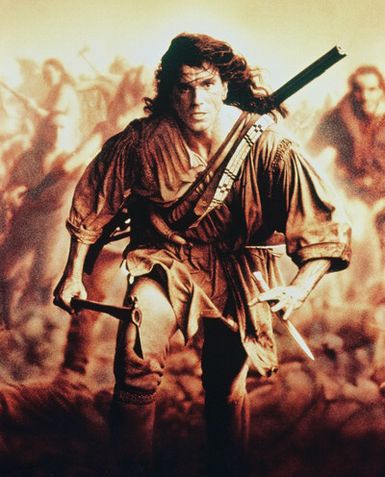
So I'm not completely mealy-mouthed about changing books. On the whole, though, changing a story for a screen version is nothing short of hubris on the part of the screenwriter/director. It's also the ultimate smack in the face, not only for the writer, but for the readers who loved the book, made it successful and brought it to the attention of film-makers in the first place. Hollywood is so self-obsessed that it doesn't seem to realise there is a reason for the popularity of the original book: the story. When you change the ending or the characters or the plot, you often destroy the story.
Meryl Streep is, of course, an excellent actor and she played Miranda Priestley very well and with a fabulous sneer, but her version of the character is only a pale reflection of Weisberger's Bitch From Hell. And it's all the screenwriters' fault. There's an excellent reason why Salinger has never sold film rights for Catcher in the Rye.
Labels: movies
posted by redcap @ 8:50 pm
10 comments


